
GHK-Cu is the copper peptide behind a lot of confident claims and a surprisingly small amount of human trial data. Here is where it came from, what the published work actually measured, and which parts of the story are still animal and laboratory research.
GHK is a very short peptide, just three amino acids: glycine, histidine and lysine. That is where the name comes from, one letter per amino acid. The Cu on the end is the chemical symbol for copper, because the peptide grips a copper ion. The combined thing, the copper complex, is what almost all of the research studies.
It is not a synthetic invention. This sequence circulates in human blood, which is unusual for a compound in this category and is a large part of why it attracted attention in the first place. It was originally noticed in work on human plasma, not designed in a laboratory to do a job.
Copper is a trace element the body needs in small amounts and handles very carefully, because loose copper is chemically reactive and damaging. Proteins that carry it hold it tightly and hand it off deliberately. The interest in this tripeptide is that it appears to be one of those carriers: a small molecule that can bind copper and move it, rather than a molecule that happens to have a metal stuck to it.
It was identified in 1973 in work on human plasma, and the researcher behind that discovery, Loren Pickart, has been the central figure in the field ever since. The original observation came out of studying what in plasma affected the behaviour of liver cells in culture, and the active fraction turned out to be this tripeptide.
A large share of the review literature, including the widely cited 2018 paper in the International Journal of Molecular Sciences (volume 19, article 1987), is authored by Pickart with Anna Margolina. That is worth naming plainly. It is not an accusation, and it is a real limitation: when the summaries of a field and the discovery of the compound share an author, independent replication carries more weight than another review. Readers should weight primary papers from unrelated groups more heavily than any summary, including that one.
That is the claim, and it comes with numbers. The 2018 review states that at age 20 the plasma level of GHK is about 200 ng/mL, and by age 60 it declines to 80 ng/mL. That is roughly a 60 percent fall across four decades.
Treat it as a reported figure rather than a settled constant. It is quoted in review articles rather than derived from a large population study with published methods and confidence intervals, and the same pair of numbers is repeated across the secondary literature without independent replication being easy to find. A falling plasma level is also not, by itself, evidence that restoring it changes anything.
This is the most impressive sounding part of the story and the most frequently overstated. The reviews report that the peptide up and downregulates thousands of human genes, with a figure of around 4,000 in wide circulation, and that in an analysis of DNA repair genes 47 were stimulated and 5 suppressed at a threshold of a 50 percent change or greater.
Where does that come from? The Broad Institute Connectivity Map, a public database that records how gene expression in cultured cell lines shifts after exposure to a compound. It is a screening tool. It is genuinely useful for generating hypotheses about mechanism, and it is a long way from a clinical result.
That a compound changes expression of many genes in cultured cells is not the same as it doing anything useful in a person. Broad transcriptional effects are common in these screens and can indicate general cellular stress as easily as targeted activity. The phrase resetting DNA to a healthier state appears in the review literature and it is interpretation, not measurement. The measurement is a list of expression changes in a dish.
The published work clusters into a few areas, and the evidence tier differs sharply between them:
Less than the volume of writing about it suggests. The human studies that exist are cosmetic, small, and measure appearance endpoints such as wrinkle depth or skin roughness rather than tissue repair. One randomised double blind comparison of a copper peptide formulation against a commercial cosmetic peptide reported a 31.6 percent reduction in wrinkle volume. That is a real result in a real design, and it is a cosmetic endpoint in a small study, which is a different claim from regenerative medicine. Wrinkle volume is measured by imaging the skin surface. It does not measure collagen laid down, follicles restored or tissue repaired, and the gap between those two kinds of endpoint is where most of the overstatement in this category happens.
Here is the primary source, because it is almost never quoted directly. Uno and Kurata published in the Journal of Investigative Dermatology in 1993, volume 101, supplement, pages 143S to 147S. The paper reviews a decade of work on chemical agents and peptides in hair growth models. A copper binding peptide designated PC1031 produced follicular enlargement on the back skin of fuzzy rats, covering the vellus follicles, and the authors describe that effect as similar to topical minoxidil.
Read that carefully, because the popular version drifts. It is fuzzy rats, not people. It is follicular enlargement, which is a measurement of follicle size. It was published in 1993 as a conference supplement, and no completed randomised human trial of this compound for hair has been published in the three decades since. Minoxidil, by contrast, holds an FDA approval for androgenetic alopecia in both men and women and has a multi decade placebo controlled record behind it.
The uncomfortable list, which is the one worth reading:
An evidence ranking for this compound, strongest claim first.
| Claim | Evidence tier | Honest reading |
|---|---|---|
| Occurs naturally in human plasma and binds copper | Established chemistry | Well characterised and not in dispute |
| Changes gene expression in cultured cells | Screening database | Real data, hypothesis generating, not a clinical outcome |
| Affects wound healing measures | In vitro and animal | Consistent direction across models, not tested in a large human trial |
| Cosmetic skin appearance in humans | Small human studies | Real designs, small numbers, appearance endpoints |
| Grows hair in people | Not established | Rests on a 1993 fuzzy rat result. No published human trial |
A copper complex is a slightly harder sourcing problem than a plain peptide, because there are two things to get right. Ranked by how much they matter:
Every NXTSTATE batch goes to an independent third-party laboratory and every result is published, including the quantity assays, on our lab reports page.
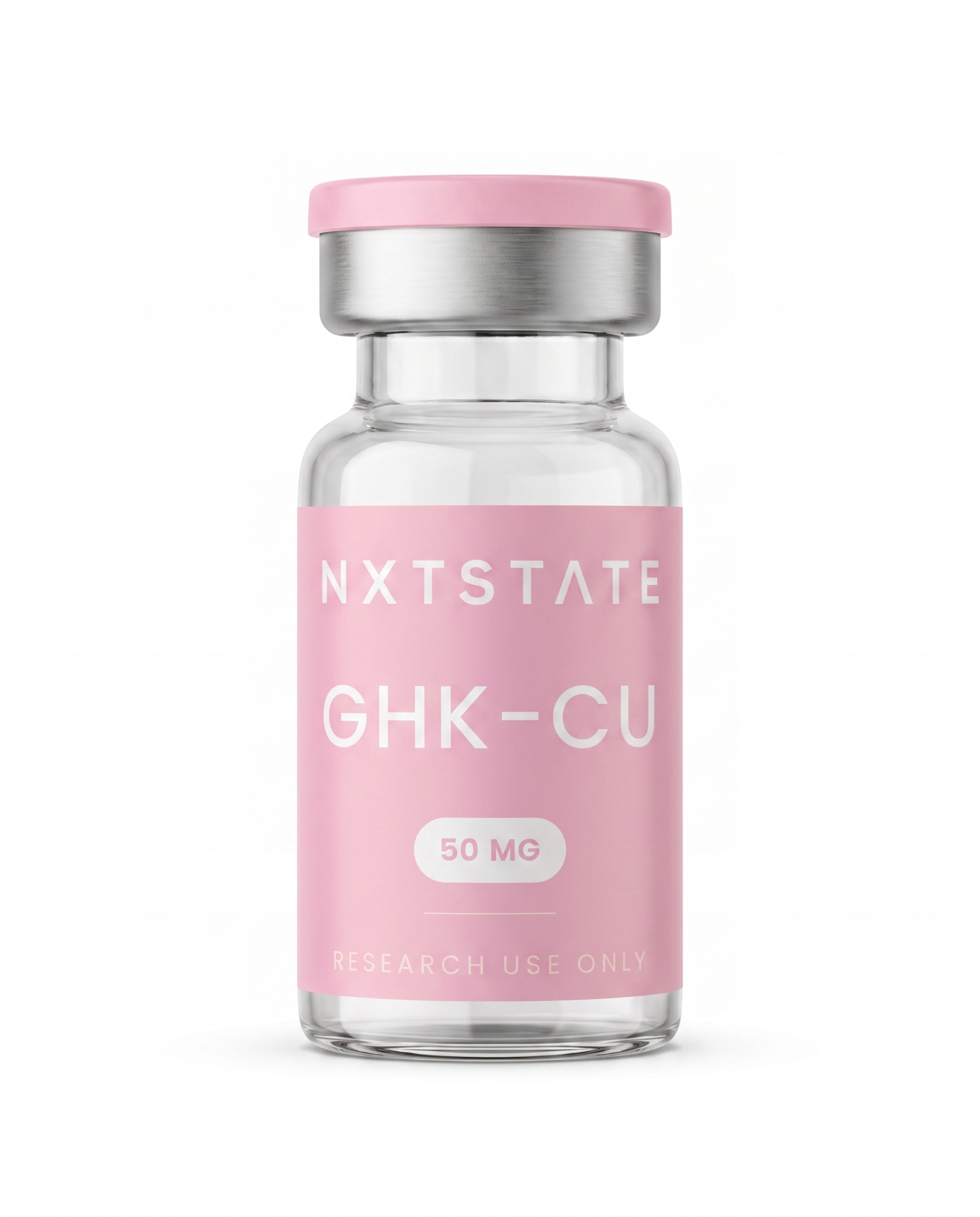
Shop NXTSTATE GHK-Cu
Research-grade copper tripeptide for laboratory use. Independent third-party lab tested, with purity and quantity both published.
View GHK-Cu →Copper peptide is the loose category name and this is the specific molecule most people mean by it. There are other copper binding peptides, and cosmetic labelling in particular uses the general term for several different ingredients. If a product says copper peptide without naming a sequence, you do not know what is in it. That distinction matters in research, where the identity of the compound is the whole point, and it matters when comparing published results between products.
The colour comes from the copper. Copper complexes absorb light in the red part of the spectrum and reflect blue, which is why solutions of this compound take on a distinct blue tint that plain peptides do not have. It is a useful visual signature rather than a quality measure. A blue solution tells you copper is present and coordinated. It does not tell you the peptide is intact, the concentration is right, or the batch is what the label says.
The published record does not support saying so. Regrowth is a regulated drug claim in the United States and it belongs to compounds holding an approval for that indication, which for topical use means minoxidil. What exists for this compound is a 1993 paper reporting follicular enlargement in fuzzy rats with a copper binding peptide, described by the authors as similar to topical minoxidil in that model. Animal follicle measurements from three decades ago are a reason to keep studying something. They are not a human efficacy finding.
That question cannot be answered here, and not because of evasiveness. This is a research-grade compound sold for laboratory use only, and no safety guidance for human exposure exists on our part because no such use is intended or supported. What can be said about the literature is that formal human safety datasets are limited to small cosmetic studies of topical formulations, and that copper itself is an element the body regulates tightly, which is a reason the toxicology of any copper carrying compound deserves care rather than assumption. No long term human safety study of this compound has been published, and the absence of reported problems in small short studies is not the same as a demonstrated safety record.
They sit in a similar tier for different reasons. Both have large preclinical literatures with consistent direction, both lack a completed published human efficacy trial, and both attract stronger claims than the data supports. The copper peptide has a small set of human cosmetic studies that its counterpart does not, and those measure appearance rather than repair. Neither is approved anywhere. If you are ranking by evidence rather than by enthusiasm, the honest verdict for both is promising preclinical work awaiting human confirmation.
It is the fraction of the material that chromatography identified as the target compound. Our published figure for this compound is 99.439 percent on report #96281. Two things worth knowing about that kind of number. First, chromatography never returns a clean 100.0 percent, so a catalogue where everything shows the same tidy figure is describing its paperwork rather than its product. Second, purity says nothing about how much is in the vial, which is a separate assay.
One thing: an adequately powered randomised controlled trial with a clinical endpoint, run by a group with no connection to the compound’s discovery, and published in full. That is what the field has never had. The gene expression screens, the animal wound work and the small cosmetic studies are all consistent with something real, and none of them substitutes for that trial. Until it exists, every confident claim about this molecule in humans is an extrapolation, and it should be read as one.
NXTSTATE supplies research-grade compounds for laboratory research purposes only. Not for human consumption, medical, or diagnostic use. We do not provide dosing, protocol, or medical advice.